Read transcript
The engines were still running. But both generators had dropped off the electrical network, and several cockpit screens went dark. Beneath the aircraft, a small turbine deployed into the airflow. Why would a plane with working engines need this? Airbus describes this happening to an A319 during descent. The problem was not a loss of thrust. It was a loss of normal electrical generation.
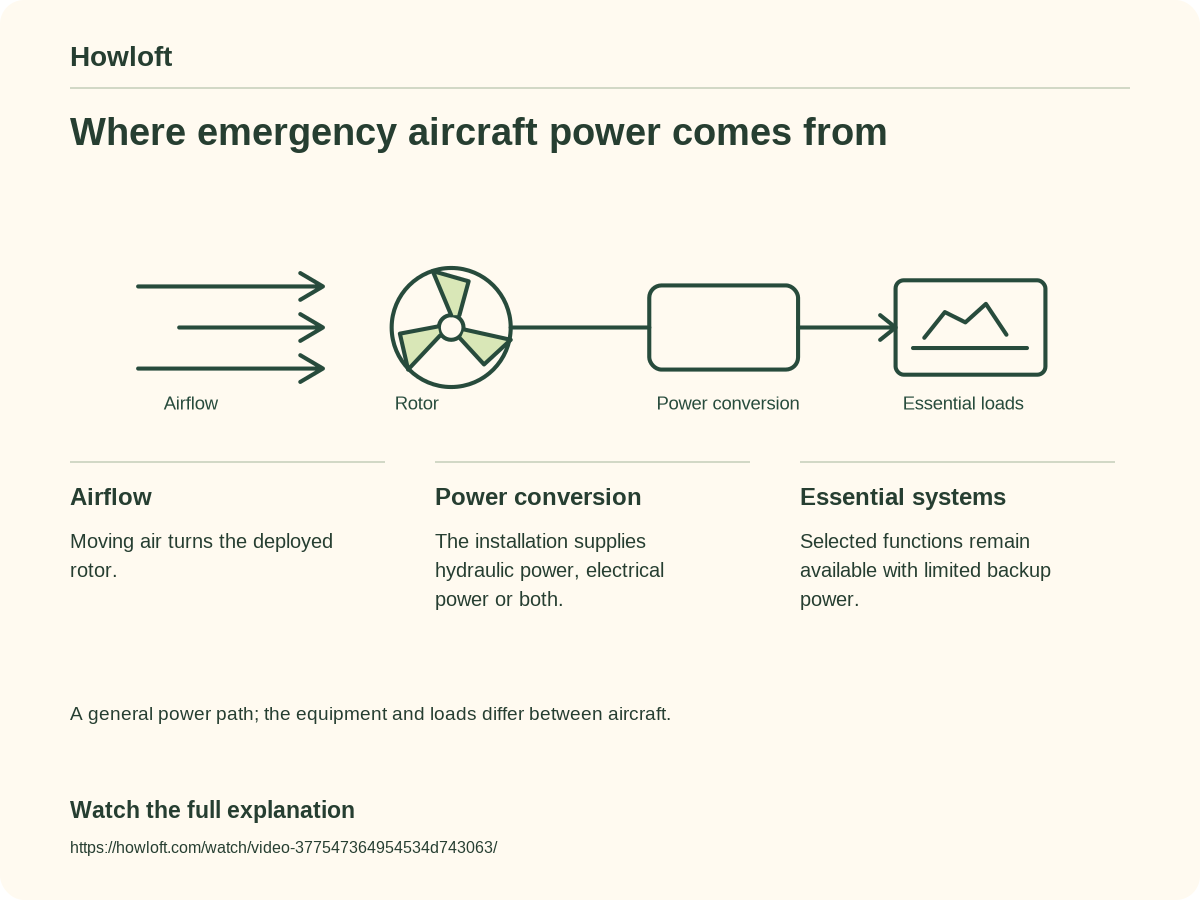
Inside each engine's generator drive, worn hydraulic components disrupted speed regulation. The electrical frequency wandered. Control units disconnected the generators to protect the aircraft's equipment, one after the other. The aircraft entered its emergency electrical configuration, and the ram air turbine, or RAT, deployed. Airflow turns its blades. The blades turn a shaft.
Instead of using power to push the aircraft forward, this rotor extracts power from the air passing it. What happens next depends on the aircraft. Some RATs provide hydraulic power, some electricity, and some both. In a documented A320 arrangement, the turbine drives a hydraulic pump. That hydraulic power can also turn a motor coupled to an emergency generator. Follow the chain: airflow, rotation, fluid pressure, then electricity.
The rotor needs controlled speed, too. One patented design uses spinning weights working against springs to adjust blade pitch. That is a representative governor, not proof of this A319's exact hardware. Back in the event, emergency power did not restore normal operation. The captain's flight and navigation displays and the upper system display remained on. The autopilot and automatic thrust control disconnected.
The crew successfully reset one generator, restoring the full electrical supply. They later recovered the second, and the aircraft landed safely. The RAT did not repair the worn components. It supported essential systems while the crew dealt with the failure. Those big engines make the aircraft move. This small backup uses that movement to obtain emergency power. Different jobs, connected by the same airflow.