The contacts have opened, but electricity can still cross the gap. So how does a circuit breaker actually stop a fault?
Follow a representative thermal-magnetic miniature circuit breaker: a bimetal strip responds to sustained overload, a magnetic coil reacts to sufficiently large fault current, and an arc chamber helps interrupt the conducting path. See why trip-free operation matters and how an RCD detects a different danger.
00:00 Why an open gap is not enough
00:12 Overload vs short circuit
00:28 Thermal trip: the bimetal strip
00:49 Magnetic trip: the coil and plunger
01:13 Extinguishing the arc
01:31 Trip-free protection
01:44 Circuit breaker vs RCD
02:02 Resetting is not repairing
Original Howloft illustrative 3D animation. Geometry, timing and motion are simplified for explanation; designs and trip characteristics vary. This is not an electrical repair guide or a certified simulation. Never open, modify or defeat a live protective device. Repeated tripping needs a qualified electrician.
Explore more: https://howloft.com/
Subscribe to Howloft for the mechanisms hidden inside everyday things.
#CircuitBreaker #HowItWorks #ElectricalEngineering
From fault detection to interruption
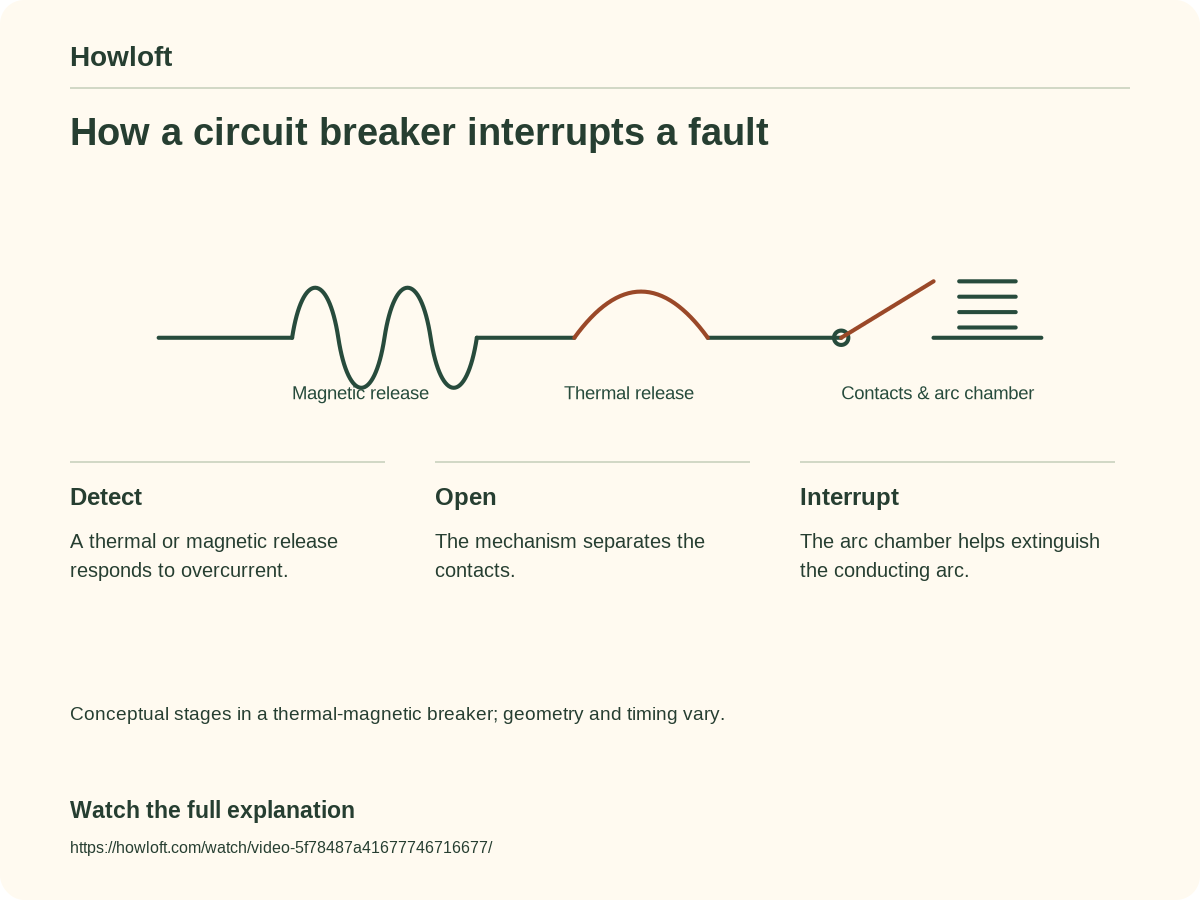
01DetectA thermal or magnetic release responds to overcurrent.
02OpenThe mechanism separates the contacts.
03InterruptThe arc chamber helps extinguish the conducting arc.
Conceptual stages in a thermal-magnetic breaker; geometry and timing vary.
The contacts have opened, but electricity is still crossing the gap inside this breaker. Opening a switch is only part of stopping a fault. First, it has to notice trouble. An overload means too much current through the normal circuit for too long. A short circuit creates a fault path that can carry a much larger current almost immediately. A common thermal-magnetic miniature breaker responds in two different ways.
For an overload, current heats a strip made from two bonded metals. They expand by different amounts, so the strip bends far enough and trips the mechanism. A larger overload generally heats it faster. This delay lets brief surges, such as a motor starting, pass without an unnecessary trip. A severe short circuit needs a faster response. Current also flows through a coil.
A sufficiently large current creates a strong magnetic field that moves a plunger and trips the mechanism. In some miniature breakers, that plunger also strikes the moving contact directly. Instantaneous means no intentional delay, not zero time. Now the contacts separate, but hot ionised gas can carry current across the gap as an arc. The breaker drives that arc into an extinguishing chamber.
In this design, metal plates split it into smaller arcs, helping cool and interrupt the conducting path. There is another safeguard. The mechanism is trip-free. Holding the handle on does not prevent a protective trip from opening the contacts. An ordinary breaker protects wiring against excessive current. It is not complete protection against electric shock.
A residual current device detects imbalance between outgoing and returning current. Some devices combine both functions. And resetting a breaker does not repair whatever caused it to trip. Repeated tripping needs a qualified electrician. So that little handle hides a chain. Detect the fault. Open the contacts. Extinguish the arc. Each step matters. Subscribe to Howloft to see the mechanisms hidden inside everyday things.
Why does an overload take longer to trip?
In a representative thermal-magnetic breaker, sustained excess current heats a bimetal strip. The strip bends until it releases the trip mechanism. A sufficiently large fault current can instead operate the magnetic release rapidly. The actual response depends on the breaker, current and conditions; there is no single trip time for every fault.
Why can current cross open contacts?
Separating the contacts can create a conducting arc. The arc chamber helps split, cool and extinguish that arc so the circuit can interrupt current. The animation slows this process down so you can follow the contacts and arc chamber separately.
A breaker and an RCD look for different problems
Overcurrent protection responds to excessive current. Residual-current protection detects an imbalance between the currents flowing out and returning. Some devices combine both functions. Resetting a tripped device does not remove the underlying fault.
Common questions
Does holding the handle on prevent a trip?
A trip-free mechanism can open the contacts even if the handle is held in the on position. The video shows the principle; never try to defeat a protective device.
Does every breaker use the same internal mechanism?
No. This explanation follows a representative thermal-magnetic miniature breaker. Designs, ratings and trip characteristics vary.